
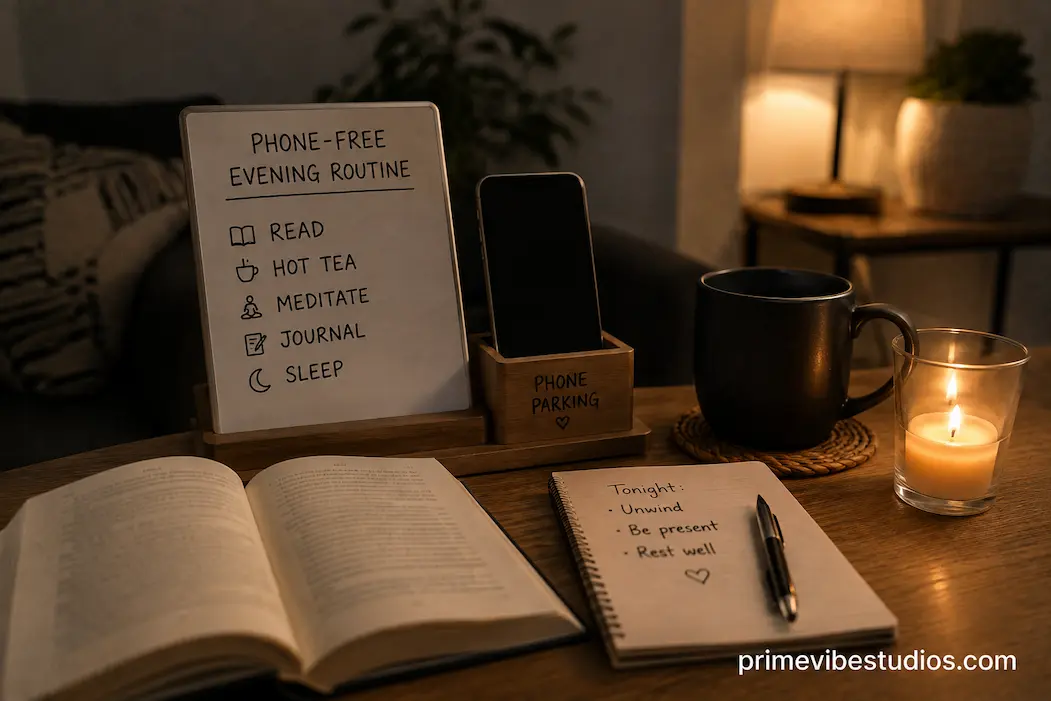
A phone-free evening sounds simple until you try to make one happen consistently. Most people don’t intentionally decide to spend the entire evening scrolling. The phone is usually pulled out for one small reason: checking a message, looking something up, replying to an email, watching a short video, or simply filling a few quiet minutes. One small check can easily turn into half an hour, especially when the device is always within reach.
The problem with many digital-detox plans is that they are too strict to survive normal life. Telling yourself that you will never touch your phone after 6 p.m. might work for a day or two, but it becomes difficult when you need to coordinate dinner, receive an important message, check a travel detail, or use your phone for something genuinely useful. A maintainable evening routine needs to leave room for those situations rather than treating every phone interaction as a failure.
A better approach is to decide when your phone is useful, when it is distracting, and what you want to do instead. The goal isn’t to prove that you can live without a smartphone for several hours. It is to create an evening where the phone stops being the default activity. Once that distinction becomes clear, building a routine becomes much easier.
Start With A Realistic Phone-Free Window
The first mistake is choosing a phone-free period that is too ambitious. If you normally use your phone until midnight, immediately deciding that you will stop using it at 6 p.m. creates a huge gap between your current habits and your new routine. That gap requires considerable willpower, and willpower tends to become less reliable as the evening progresses.
Instead, choose a specific window that feels achievable. For example, you might start with the final 45 minutes before bed. Once that becomes comfortable, extend it to an hour or two. Someone else might find it easier to put the phone away immediately after dinner. There is no universal starting point because your schedule, responsibilities, and existing habits are different from someone else’s.
The important thing is consistency rather than duration. A 45-minute phone-free period that you maintain most evenings is more useful than a three-hour plan that collapses after four days. Once the behavior becomes familiar, increasing the window becomes much easier because you are no longer building the habit from scratch.
Choose An Anchor Instead Of A Perfect Time
Rather than saying, “I will stop using my phone at 8:00 p.m.,” connect the routine to something that already happens every evening. Dinner finishing, brushing your teeth, changing into comfortable clothes, or preparing for bed can become the signal that starts your phone-free period.
This works because you don’t have to remember a new rule every night. The existing activity becomes the trigger for the new behavior. Once dinner is finished, for example, your phone goes to its charging location and the rest of your evening follows a familiar sequence.
An anchor also makes the routine more flexible. If dinner happens at 7:00 p.m. one evening and 8:00 p.m. the next, the routine can move with your schedule. You aren’t failing simply because your evening doesn’t happen at exactly the same time every day.
Decide What “Phone-Free” Actually Means
A phone-free evening doesn’t necessarily mean the device has to disappear completely from your home. For some people, that would be unrealistic. The more useful question is what types of phone use you want to remove.
You might decide that social media, short-form video, casual browsing, gaming, and unnecessary messaging are off-limits after your chosen evening anchor. At the same time, you may still allow calls from family, emergency contacts, navigation when necessary, or an important work-related message if your responsibilities require it.
This distinction prevents the routine from becoming unnecessarily restrictive. If your partner needs to reach you, or you are waiting for an important call, there is no reason to consider answering it a failure. The purpose of the routine is to reduce mindless use, not create anxiety about legitimate communication.
Create A Simple Rule You Can Remember
Your rule should be short enough that you can remember it without checking your phone.
Something like “No social apps after dinner” is easier to follow than a complicated list containing fifteen exceptions. Another option is “Phone stays on the charger unless I need it for something specific.” The second rule focuses on intention rather than banning every possible use.
You can also separate essential communication from entertainment. If you need to make a call, do it and put the phone away afterward. If you need to check tomorrow’s weather, check it and stop there. The objective is to prevent a useful task from becoming an excuse for unrelated browsing.
A simple rule is particularly important on difficult evenings. When you’re tired, you would rather not negotiate with yourself about whether opening one particular app technically violates your plan. A clear rule reduces that decision-making.
Give Your Phone A Permanent Evening Home
Where you place your phone matters more than many people realize. If it stays beside you on the sofa, dining table, or next to your bed, you have to actively resist picking it up every time you see it. That creates unnecessary friction.
Choose a specific charging location away from your normal evening seating area. It could be a shelf, desk, hallway table, or another location that is easy to reach when necessary but inconvenient enough to discourage casual checking.
This changes the environment instead of relying entirely on self-control. When the phone isn’t physically in your hand or sitting directly beside you, the number of opportunities to check it naturally decreases.
The charging location can also become part of your evening ritual. After your anchor activity, put the phone there, connect it to the charger, and move on to the next part of your routine. Repeating the same sequence makes the behavior increasingly automatic.
Keep The Phone Out Of The Bedroom If Possible
For many people, the bedroom is where phone habits become hardest to control. A phone beside the bed provides an easy source of entertainment when you’re tired, and it can turn bedtime into another period of scrolling.
Moving the phone outside the bedroom creates a physical boundary between nighttime and casual phone use. If you use your smartphone as an alarm, consider whether another alarm clock could serve that purpose instead. Removing the phone from the bedside area eliminates the temptation to check notifications when you wake during the night.
This doesn’t mean everyone needs to make their bedroom completely technology-free. The useful principle is simply to avoid making the phone the final object you interact with before sleeping and the first thing you reach for when you wake.
Replace Scrolling With Something Specific
One reason phone-free routines fail is that people remove the phone without replacing the activity it was providing. They put the device away, sit down, become bored, and eventually pick it up again.
Your brain needs an alternative. That doesn’t mean you need an elaborate hobby. Reading several pages of a book, preparing something for tomorrow, listening to music, stretching, doing a simple household task, writing in a notebook, or talking with someone can provide enough structure to prevent the evening from feeling empty.
The replacement should also match your energy level. If you’re exhausted after a long day, you may not realistically spend two hours learning a new skill. A quiet activity that requires little preparation is much more likely to become part of the routine.
Build A Short Menu Of Alternatives
Instead of deciding every night what to do, create a small list of activities you genuinely enjoy. Keep it somewhere that doesn’t require opening your phone to access it.
Your list might include:
- Reading a physical book
- Preparing clothes or meals for the next day
- Taking a short walk
- Doing light stretching
- Journaling
- Listening to music
- Working on a hobby
- Having an uninterrupted conversation
- Tidying one small area of the home
The list doesn’t need to be long. Its purpose is simply to eliminate the “What am I supposed to do now?” moment that often sends people back to their phones.
Don’t Turn The Routine Into Another Productivity Project
There is a temptation to make every phone-free evening extremely productive. You might decide that every evening should include reading, exercise, meal preparation, planning, learning, cleaning, and meditation.
That can defeat the purpose.
An evening without constant phone use should also leave room for doing very little. Sitting with a cup of tea, listening to music, looking out the window, speaking with family, or simply relaxing can be perfectly worthwhile. Not every minute needs to produce an achievement.
If your new routine becomes another demanding schedule that you feel guilty about failing to complete, you may eventually abandon it. The goal is to create a calmer relationship with technology, not replace scrolling with another source of pressure.
A sustainable routine has enough structure to guide you but enough flexibility to accommodate ordinary life.
Make Notifications Less Tempting
Even when you aren’t actively using your phone, notifications can pull your attention toward it. A screen lighting up or a vibration from across the room can create the urge to check what happened.
Before beginning your phone-free period, review which notifications actually need to reach you during the evening. You can use built-in notification controls, Do Not Disturb, Focus modes, or similar settings to reduce interruptions while still allowing important contacts to reach you.
This is particularly useful if your phone needs to remain nearby for safety or family reasons. You don’t necessarily have to switch it off completely. You can make the phone quieter while keeping essential communication available.
It’s best to decide these settings in advance. If you wait until a notification appears and then decide whether to check it, you’re deciding at the exact moment when the temptation is strongest.
Don’t Replace Phone Scrolling With Another Screen
Putting down a phone only to spend the next two hours watching television or browsing on a tablet doesn’t necessarily create the kind of evening you were looking for.
There is nothing inherently wrong with watching a film or using another screen. The problem is when the goal is specifically to reduce passive digital consumption and the same habit simply moves to another device.
Think about what you actually want from your phone-free evening. If you want less social media and fewer interruptions, watching a planned movie may fit perfectly well. If you want to spend more time away from screens altogether, choose an offline activity instead.
The distinction is important because “phone-free” and “screen-free” are not necessarily the same goal.
Create A Transition Ritual
Going directly from a busy day of messages, work, browsing, and notifications into complete silence can feel strange. A short transition can help your brain recognize that the day is changing.
You could take five minutes to tidy your workspace, prepare a drink, change clothes, dim the lights, or write down anything you need to remember for tomorrow. The specific activity doesn’t matter as much as the consistency.
The transition ritual tells you that the active part of the day is ending. Once it becomes familiar, putting your phone away won’t feel like an isolated restriction. It will become one part of a larger evening sequence.
This is especially helpful for people who use their phones heavily for work. If your phone is closely associated with emails, messages, appointments, and tasks, simply putting it down may not be enough to mentally disconnect. A transition gives you a clearer boundary.
Deal With The “I Just Need To Check One Thing” Problem
The most dangerous moment isn’t always boredom. Sometimes it’s the belief that you need to check something quickly.
You may want to check tomorrow’s weather, search for a recipe, look up an address, confirm a delivery, or answer one message. The original task may take thirty seconds, but the phone can provide dozens of distractions immediately afterward.
Create a rule for these situations. If something genuinely needs to be checked, do the specific task and then put the phone away immediately. Don’t treat the necessary task as permission to browse unrelated content.
For recurring needs, move some tasks away from the phone. A written shopping list, physical calendar, alarm clock, or simple notebook can reduce the number of reasons you need to reach for the device.
The objective isn’t to make phone use impossible. It’s to make intentional use different from automatic use.
Prepare For The Moments When The Routine Breaks
A sustainable routine isn’t one that you follow perfectly. It is one that you can return to after an interruption.
There will be evenings when you need your phone. You may be traveling, waiting for an important call, dealing with an unexpected problem, working late, or simply having a different kind of day. Those situations don’t mean the routine has failed.
Avoid the all-or-nothing mindset. If you normally put your phone away at 8:30 p.m. but use it until 9:15 p.m. one evening, don’t decide that the entire plan is ruined. Put it away when you can and continue the routine.
This matters because perfection creates unnecessary pressure. A habit becomes sustainable when a missed day is treated as a temporary interruption rather than evidence that the entire approach doesn’t work.
Have A Minimum Version
It can help to create a smaller version of the routine for difficult days.
Maybe your normal goal is two hours without recreational phone use, but on a particularly busy evening you only manage thirty minutes. That still gives you a clear way to maintain the habit.
The minimum version might simply be:
Phone on charger → notifications reduced → prepare for bed → no recreational scrolling for the final 30 minutes.
Having this fallback prevents the routine from disappearing whenever your schedule becomes unpredictable.
Over time, consistency becomes more important than achieving the longest possible phone-free period.
Make The Morning Easier Too
An evening routine can be easier to maintain when it solves a problem you would otherwise experience the next morning.
Before putting your phone away, prepare what you need for tomorrow. Lay out clothes, organize your work bag, write down an important task, or prepare breakfast ingredients. These small actions can give the evening a purpose beyond simply avoiding your phone.
They also reduce the temptation to reach for the phone early in the morning because you already know what needs to happen next.
This creates a useful connection between evening habits and morning habits. The phone-free period isn’t an isolated experiment. It becomes part of a broader routine that helps separate work, entertainment, rest, and sleep.
The more practical benefits you notice, the easier it becomes to continue.
Measure The Habit Without Obsessing Over It
You don’t need a complicated tracking system to know whether your routine is working.
For the first couple of weeks, simply notice how often you complete your chosen phone-free period and how you feel about it. You might discover that you sleep more comfortably, spend more time talking with family, read more, or simply feel less mentally occupied by incoming information.
Don’t assume that putting the phone away causes every change. Your experience will depend on many factors. Instead, use the observations to decide whether the routine is useful enough to keep.
If something consistently makes the routine harder without providing a meaningful benefit, change it. The system is yours; you don’t need to follow an arbitrary digital-detox formula.
A Practical Evening Routine To Start With
If you’re unsure where to begin, keep the first version simple.
After dinner, finish any genuinely necessary phone tasks. Put the phone on its charging location, activate your preferred notification controls, and choose one offline activity. Spend the next 30–60 minutes doing something that doesn’t require the phone. When you’re ready for bed, prepare what you need for the following morning and leave the phone away from the bedside if possible.
After several days, evaluate what worked.
Maybe 60 minutes feels easy and you can extend it. Maybe dinner is too early and a later anchor works better. Perhaps you discover that keeping the phone in another room is more effective than using notification controls. Adjust the routine according to what actually happens rather than what you think should happen.
That experimentation is part of building a sustainable habit.
Build A Routine You Don’t Have To Fight
A phone-free evening shouldn’t feel like punishment for using technology during the day. Your smartphone is useful for communication, information, entertainment, navigation, work, and countless ordinary tasks. The problem begins when it becomes the automatic answer to every quiet moment.
The most sustainable solution is therefore not to create an extreme rule. Choose a realistic starting window, give the phone a permanent evening home, reduce unnecessary notifications, and decide beforehand what you will do with the time you have reclaimed. Keep essential communication available when necessary, and don’t treat an occasional interruption as a failure.
Most importantly, allow the routine to evolve. Your ideal evening may not look like somebody else’s digital-detox routine, and it doesn’t need to. The best phone-free evening is one that fits naturally into your real life well enough that you can keep doing it long after the initial motivation disappears.
Frequently Asked Questions
How Long Should A Phone-Free Evening Routine Be?
There is no required duration. Starting with 30–60 minutes is reasonable for many people because it creates a meaningful break without requiring a dramatic lifestyle change. If that becomes comfortable, you can gradually extend the period.
Should I Turn My Phone Off Completely At Night?
You don’t necessarily need to. If you need to remain reachable, use Do Not Disturb, Focus settings, or similar controls to allow important calls while reducing unnecessary notifications. The goal is to reduce recreational and automatic use, not make legitimate communication impossible.
What If I Need My Phone For An Important Message?
Please handle the necessary task and return the phone to its designated location afterward. A phone-free routine should allow reasonable exceptions for genuine needs. The important distinction is between intentional use and automatically continuing to browse after the original task is finished.
What Can I Do Instead Of Using My Phone At Night?
Choose activities that match your energy level, such as reading, listening to music, preparing for tomorrow, stretching, journaling, talking with family, cooking, or working on a hobby. Having several options ready makes it easier to avoid falling back into scrolling.
Why Do Phone-Free Routines Keep Failing?
They often fail because they are too restrictive, don’t provide an alternative activity, or rely entirely on willpower. A routine is more sustainable when it has a realistic starting point, a clear trigger, a convenient place for the phone, and activities you genuinely enjoy.