
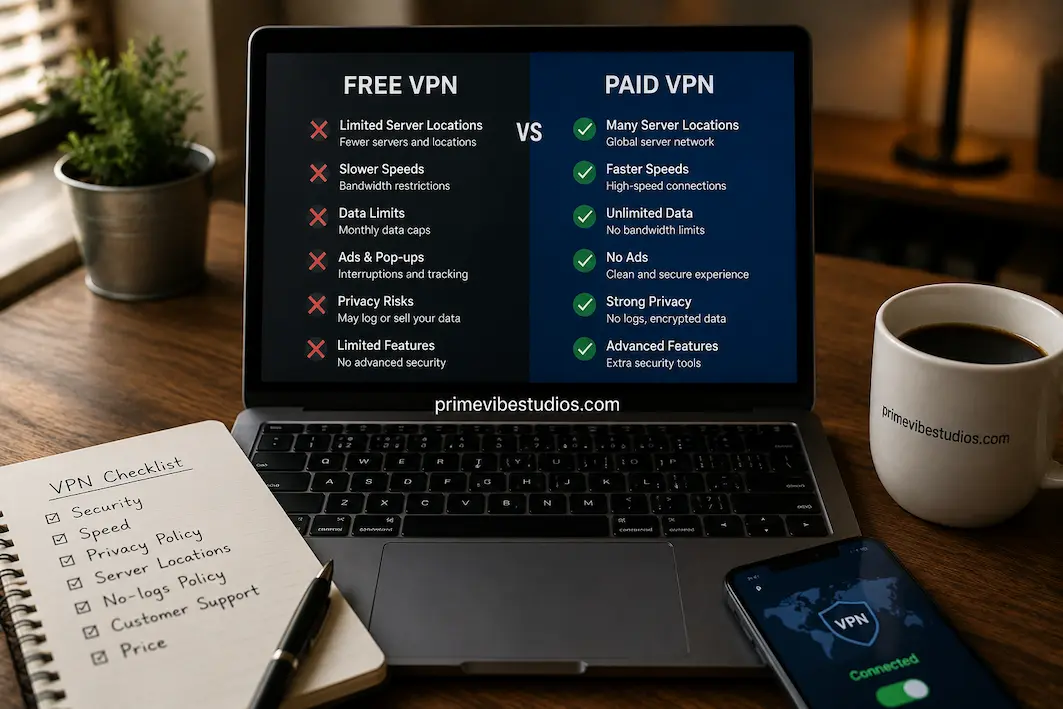
A VPN can sound like a simple product: install an app, connect to a server, and browse the internet through a different network connection. The reality is a little more complicated, especially when you compare free VPNs with paid services. Both can offer useful privacy features, but the differences in speed, server availability, data limits, support, and business models can make one option much more suitable than the other depending on how you use the internet.
The word free can also create the wrong expectation. Running VPN servers, maintaining applications, handling large amounts of network traffic, and operating security infrastructure all cost money. A service that doesn’t charge users directly still has to cover those expenses somehow. That doesn’t automatically make every free VPN unsafe, but it does mean you should pay attention to how the service operates and what its privacy policy actually says.
A paid VPN isn’t automatically the best choice either. Some inexpensive services have limitations, complicated cancellation policies, aggressive marketing, or features you may never use. The better approach is to compare what you’re actually getting rather than assuming that paying for a subscription automatically provides better privacy.
First, Understand What A VPN Actually Changes
When you connect to the internet normally, your device communicates through your internet connection and websites can see the public IP address associated with that connection. A VPN creates an encrypted connection between your device and a VPN server, then routes your internet traffic through that server.
As a result, websites generally see the VPN server’s IP address instead of the public IP address assigned to your normal connection. Your internet provider can still see that you’re connected to a VPN service, but the VPN connection can prevent the provider from seeing the contents of the traffic inside the encrypted tunnel in the same way it would without the VPN.
That doesn’t mean the VPN makes you anonymous. Once you sign into an account, for example, the website can still know who you are. Cookies, browser characteristics, account activity, and other tracking techniques can also identify or recognize users independently of their IP address.
What You Usually Get With A Free VPN
The biggest attraction of a free VPN is obvious: there is no subscription fee. For someone who only wants occasional VPN access and doesn’t need advanced features, that can be appealing.
Free services may provide a limited selection of servers, lower data allowances, slower speeds, or fewer simultaneous connections. Some also restrict which locations are available unless you upgrade to a paid plan. These limitations aren’t necessarily a problem if your needs are modest.
The important thing is to distinguish between a free tier from a reputable provider and a completely unknown VPN application that promises unlimited privacy at no cost. Those aren’t necessarily equivalent products. Before installing a free VPN, investigate the company behind it, its privacy policy, reputation, ownership, and business model.
Why Some Free VPNs Can Be Risky
A VPN provider handles your internet traffic, which makes trust particularly important. You’re effectively choosing another company to operate infrastructure through which your connection passes.
A provider that makes unclear claims about what it does with user information deserves caution. Be especially careful with services that make exaggerated promises such as guaranteeing complete anonymity, total protection from every online threat, or absolute invisibility.
A VPN also can’t protect you from every form of online danger. If you enter your password into a phishing website, for example, the VPN doesn’t magically recognize the site as fraudulent. If you install malicious software, the VPN doesn’t necessarily stop it. Privacy and security still depend on the websites you visit, applications you install, and choices you make.
What Paying For A VPN Usually Adds
Paid VPN services generally have more resources available for infrastructure, server capacity, development, and customer support. Depending on the provider, you may get access to more server locations, higher bandwidth, multiple simultaneous connections, and additional privacy or security features.
Paid plans may also remove data limits that make some free services inconvenient. This can matter if you regularly use a VPN rather than connecting only occasionally.
Another benefit can be consistency. If you frequently switch networks, travel, work remotely, or use public Wi-Fi, having a VPN service that performs reliably across different locations can be more valuable than simply having access to any VPN at no cost.
Speed Can Be A Major Difference
VPNs can affect connection performance because your traffic is being routed through an additional server. The impact depends on several factors, including the VPN protocol, server location, network congestion, your original connection speed, and the quality of the provider’s infrastructure.
Free VPN servers can become crowded when many users are sharing a limited pool of resources. This can result in slower browsing, buffering, or inconsistent connections, particularly during busy periods.
A well-maintained paid service may provide more capacity and a larger selection of servers. That doesn’t guarantee maximum speed in every situation, but it can make it easier to find a server that performs well from your location.
Server Locations Matter More Than A Long List
VPN advertisements often emphasize the number of countries or servers available. A large number can be useful, but quantity isn’t everything.
If you simply want a nearby server for general privacy, having hundreds of distant locations may not matter. A server close to you may provide better performance than one on another continent.
Location choice becomes more important when you’re traveling or need access to a particular region for legitimate purposes. Before paying for a subscription, check whether the provider actually offers the locations you need and whether those locations are included in the plan you’re considering.
Free Doesn’t Always Mean Limited
It’s worth avoiding the assumption that every free VPN is automatically poor. Some reputable companies offer free plans specifically to introduce users to their services, with reasonable limitations designed to encourage upgrades.
The distinction is the provider’s transparency. A free plan from a company with a clear privacy policy, established reputation, understandable limitations, and identifiable business model is easier to evaluate than an unknown application promising unlimited everything.
If a free service appears too good to be true, ask how it can afford to operate. There may be a perfectly reasonable explanation, but you shouldn’t have to guess.
Read The Privacy Policy Before Trusting The Service
VPN privacy policies can be lengthy, but you don’t necessarily need to read every sentence to get useful information. Look for clear explanations of what information the company collects, why it collects it, how long it keeps it, and under what circumstances it shares that information.
Pay attention to account information, connection or diagnostic data, device information, and any statements about activity logs. Marketing language such as “private” or “secure” doesn’t tell you as much as specific explanations of data handling.
Also check whether the company explains how it responds to legal requests and whether independent audits or other forms of verification are available. These details don’t guarantee perfect privacy, but they can make the provider’s claims easier to evaluate.
A VPN Doesn’t Stop All Tracking
One common misconception is that connecting to a VPN prevents websites from tracking you. It doesn’t.
A VPN can change the IP address websites see and encrypt traffic between your device and the VPN server, but websites can still use cookies, login accounts, browser characteristics, advertising identifiers, and other technologies.
For example, if you connect to a VPN and then sign into your regular social-media account, that service can still associate your activity with your account. The VPN doesn’t remove that relationship.
Think of a VPN as one layer in a privacy setup rather than a complete privacy shield.
What About Public Wi-Fi?
Public Wi-Fi is one situation where a VPN can be useful. When you’re using a network you don’t control, encrypting traffic between your device and the VPN server can provide an additional layer of protection.
However, modern websites and applications commonly use HTTPS encryption. This means a VPN isn’t the only thing protecting information transmitted through many websites.
You should still avoid suspicious networks, keep your device updated, and use secure websites and applications. A VPN can complement these habits, but it shouldn’t replace them.
Free VPNs And Data Limits
Data limits are one of the most noticeable differences between free and paid plans. A free VPN may allow only a certain amount of traffic each month, after which you need to wait for the allowance to reset or upgrade.
For occasional browsing, that may be perfectly adequate. If you’re using a VPN throughout the day, however, a restrictive data allowance can quickly become frustrating.
Before choosing a free plan, estimate how you’ll use it. If you only want to protect yourself while occasionally using public Wi-Fi, you may not need unlimited data. If you expect to use the VPN regularly for browsing, work, or travel, the limitations may make a paid plan more practical.
Consider How Many Devices You Need To Protect
Modern households often have several internet-connected devices. You might use a phone, laptop, tablet, and desktop, while other family members have their own devices.
Free VPN plans may limit the number of simultaneous connections or support fewer devices. Paid plans frequently allow multiple connections under one subscription, although the exact limits vary.
Don’t pay extra for an unusually high device limit if you only need one or two connections. On the other hand, if you’re trying to cover several personal devices, compare simultaneous connection limits before choosing a plan.
Don’t Pay For Features You Won’t Use
VPN providers often include features beyond basic encrypted connections. Depending on the service, these might include ad and tracker blocking, malware-domain blocking, dedicated IP options, specialized servers, automatic connection rules, or advanced networking features.
Some of these can be useful, but more features don’t automatically mean better value.
If your only requirement is securing your connection on unfamiliar Wi-Fi networks, a basic plan may be enough. Someone who regularly travels, works remotely, or needs more advanced network controls may have a different set of priorities.
Watch Out For Long Subscriptions
VPN pricing can be confusing because the advertised monthly price may apply only when you purchase a long-term subscription upfront.
A service might advertise a low monthly equivalent while charging the full subscription amount immediately. That isn’t necessarily a bad deal, but you should understand what you’re committing to before entering payment information.
Check the renewal price too. Promotional rates may increase when the initial subscription period ends. A service that looks inexpensive for the first year may cost substantially more afterward.
Cancellation Policies Matter
Before paying for any subscription, find out how cancellation works. Search for information about renewal dates, refunds, trial periods, and whether you need to cancel through the VPN provider or through an app store.
A clear cancellation process is a small but important sign that you’re dealing with a service that respects customers.
If a provider makes it difficult to understand what happens when you cancel, consider that part of the overall value calculation. The cheapest subscription isn’t necessarily the best deal if leaving it becomes unnecessarily complicated.
How To Compare A Free And Paid VPN
Instead of asking whether free or paid is “better,” compare them against your actual needs.
| What You Need | Free VPN May Be Enough | Paid VPN More Likely To Help |
|---|---|---|
| Occasional public Wi-Fi protection | ✓ | |
| Very light VPN usage | ✓ | |
| No subscription budget | ✓ | |
| Large data allowance | ✓ | |
| Regular daily use | ✓ | |
| Many server locations | ✓ | |
| Multiple devices | ✓ | |
| More consistent performance | ✓ | |
| Customer support | Limited | Usually better |
| Advanced features | Limited | Usually more options |
The exact features vary significantly between providers, so use this as a starting point rather than a guarantee about every service.
When A Free VPN Makes Sense
A reputable free VPN can be reasonable if you have a limited need and understand the restrictions. Perhaps you occasionally use public Wi-Fi and want an additional privacy layer, or you want to test how a VPN affects your connection before paying for a subscription.
In that situation, a free tier can let you evaluate the application, connection process, server performance, and usability without immediately committing money.
The key is choosing the service carefully. Don’t install an unknown VPN simply because it appears at the top of an app-store search or promises unlimited privacy.
When Paying Is Worth Considering
A paid VPN becomes easier to justify when you’re going to use it frequently. If you connect every day, need more server choices, want better performance, or need to protect several devices, the additional features may provide genuine value.
Paid services can also make sense for people who travel frequently and regularly connect through unfamiliar networks. The convenience of a reliable service can be more important than saving a small monthly amount.
Still, don’t assume that every paid VPN is worth purchasing. Compare providers based on privacy practices, features, performance, device support, and total cost rather than choosing solely according to price.
Frequently Asked Questions
Is A Free VPN Better Than Having No VPN?
It depends on the service. A reputable free VPN can provide useful protection, particularly for specific situations such as connecting through unfamiliar networks. An unknown provider with questionable privacy practices may introduce different risks. Research the service before trusting it with your internet traffic.
Can A VPN Make Me Completely Anonymous?
No. A VPN can hide your normal public IP address from websites and encrypt traffic between your device and the VPN server, but it doesn’t eliminate account-based identification, cookies, browser fingerprinting, or every other tracking method.
Should I Always Use A Paid VPN?
Not necessarily. If you have occasional and limited needs, a reputable free plan may be sufficient. Paying becomes more attractive when you need frequent use, higher data limits, more locations, multiple devices, or additional features.
Does A VPN Make My Internet Faster?
Usually, you shouldn’t buy a VPN expecting it to increase your normal internet speed. Because your traffic travels through a VPN server, some connections may actually become slower. A high-quality service can minimize the performance impact, but results depend on your connection and the server you use.
Can A VPN Protect Me From Phishing?
No. A VPN doesn’t automatically identify fraudulent websites or prevent you from entering information into a fake login page. Phishing protection requires careful attention to messages, website addresses, account alerts, and other security signals.
What Is More Important: VPN Or Strong Passwords?
They solve different problems, so one shouldn’t replace the other. Strong unique passwords and multi-factor authentication protect your accounts, while a VPN can add privacy and security to your network connection. For most people, account security should remain a fundamental priority even if they use a VPN.